50.0% 50.0%;
 50.0% 50.0%;
 50.0% 50.0%;
 50.0% 50.0%;

The human foot is an extraordinary feat of biological architecture. Designed to absorb hundreds of thousands of pounds of cumulative force over a single day, it relies on a delicate balance of bone levers, muscular pulleys, and connective tie-rods. At the core of this system is a thick band of specialized tissue that acts as the primary tension bridge of your stride: the plantar fascia. When you understand how this tissue functions within the broader mechanics of your body, heel pain stops looking like an isolated injury and starts making sense as a story of tension, force transfer, and load management.
The Anatomy of the Tension Bridge
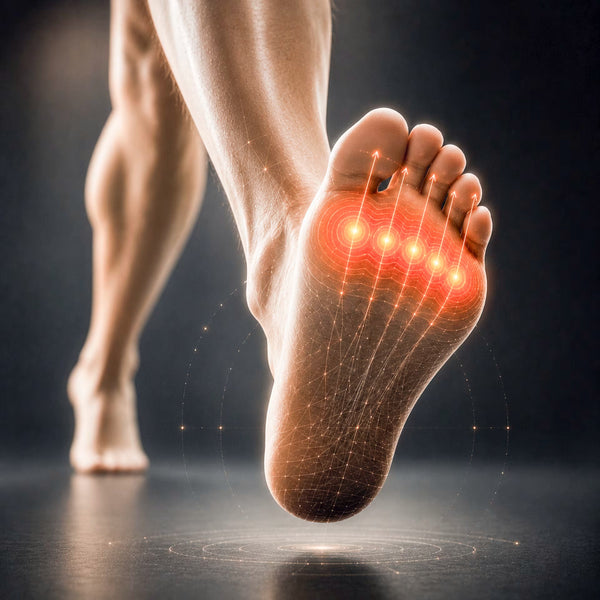
The plantar fascia is a dense, web-like band of fibrous connective tissue stretching from the inner curve of your heel bone (calcaneus) all the way to the base of your toes. Rather than acting as a static rope, it functions as a dynamic bowstring across the arch. Every time your foot lands, the arch flattens slightly to store mechanical energy—much like pulling back a bowstring. As you roll onto your forefoot to push off, your toes bend upward. This action triggers what biomechanists call the Windlass Mechanism: the bending toes pull the fascia taut over the heads of the metatarsals, shortening the distance between your heel and ball of foot, elevating the arch, and turning your soft foot into a rigid, powerful lever for propulsion.

Understanding the Strain Threshold
Because the plantar fascia is constantly cycling between tension and recoil, it operates near its mechanical limits during active movement. When the tissue is subjected to repetitive strain beyond its capacity to adapt, micro-irritation develops near its narrowest anchoring point at the heel.
- Morning Stiffness: During rest or sleep, the body attempts to repair these micro-tears by laying down temporary tissue while the foot is relaxed and slightly pointed down. The sharp pain felt during your first morning steps occurs as weight-bearing suddenly stretches that newly formed, contracted tissue back out.
-
The Load vs. Adaptation Equation: Irritation rarely stems from simple "overuse." Instead, it is triggered by sudden shifts in ground force—such as transitioning to harder surfaces, rapid spikes in training volume, or shifts in joint mobility further up the leg.
The Systemic Kinetic Chain
Your body never operates in isolation. When the plantar fascia is under chronic tension, the body instinctively adapts its movement patterns to protect the heel, creating a domino effect up the kinetic chain:
To avoid loading the inner heel, the body instinctively shifts weight onto the outer border of the foot.
Shifting weight alters the line of pull through the calf muscles (gastrocnemius and soleus) and the Achilles tendon. Tightness in the calf directly increases tension on the heel bone, creating a tug-of-war on both sides of the calcaneus.
Altering your natural foot strike shortens your stride, limiting full hip extension and placing unnatural rotational forces on the knees, hips, and lower back.
Restoring Equilibrium: The Role of Custom Insoles
Overcoming plantar strain isn't about immobilizing the foot or smothering it in generic, soft foam. In fact, soft foam inserts often squish flat under body weight, leaving the inflamed fascia to stretch unassisted across an unsupported void. Conversely, rigid plastic wedges jam into the arch, blocking natural joint motion altogether.
Restoring biomechanical harmony requires managing how ground forces enter the foot. This is where precision custom 3D-printed insoles transform the movement experience:
- Dynamic Arch Contouring: By digitally scanning the exact topography of your foot, a 3D-printed footbed supports the arch along its entire surface, distributing landing forces across 100% of the sole rather than concentrating them on the heel anchor.
- Variable Lattice Dampening: Advanced additive manufacturing allows for variable density across the footbed. Softer, shock-absorbing lattice zones under the heel offload immediate point pressure, while firmer structural zones through the midfoot gently limit excessive windlass stretch.
- Deep Heel Cup Stabilization: Cradling the heel's natural fat pad keeps the calcaneus centered, ensuring landing forces travel straight up the leg rather than twisting the fascia underfoot.